


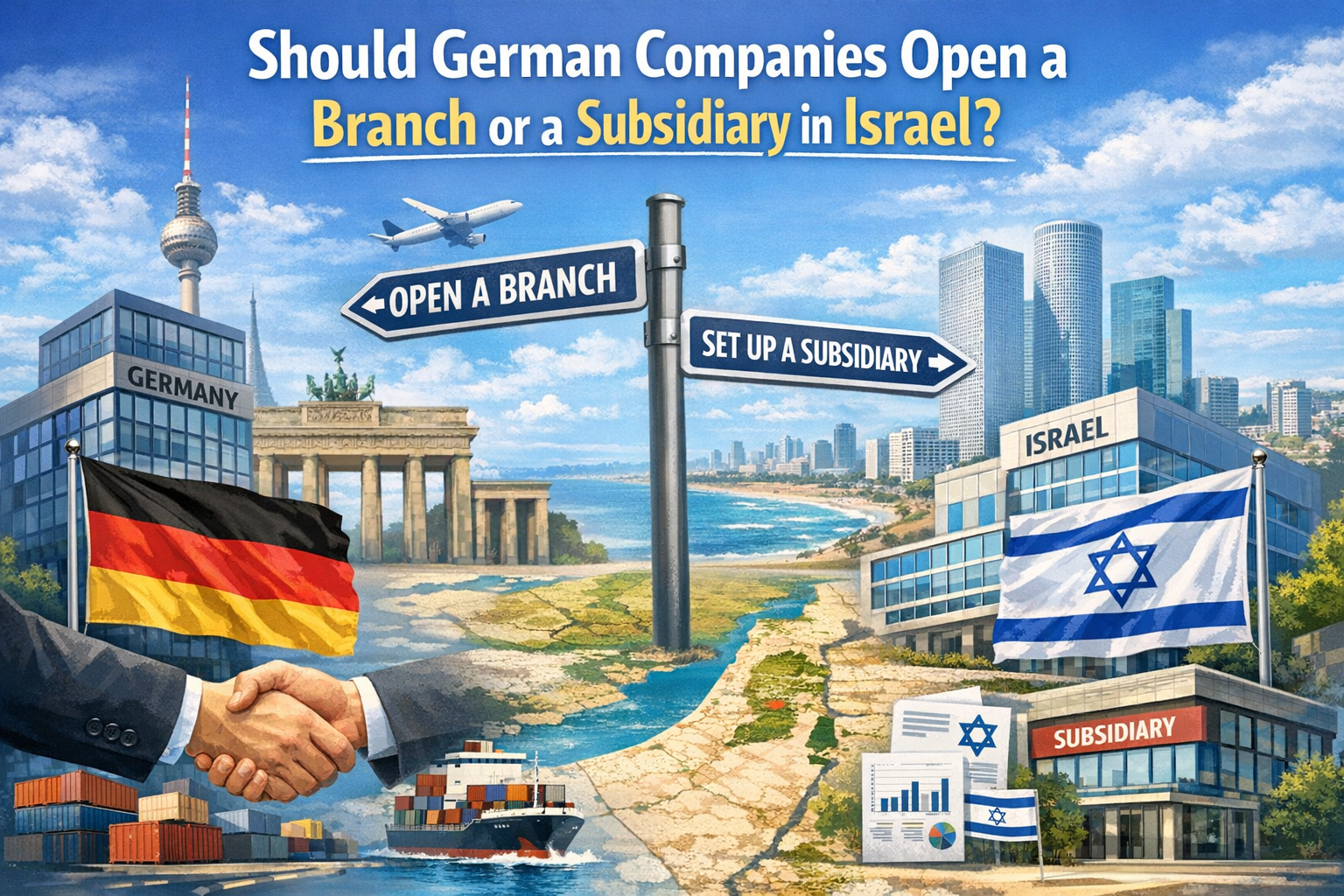
Should German Companies Open a Branch or a Subsidiary in Israel?
Why Israel Is a Strategic Market for German Businesses
Israel offers a unique combination of innovation, skilled talent, and strong trade relations with Germany. For German companies—especially Mittelstand firms—entering the Israeli market can unlock access to high-tech partnerships, government-backed R&D programs, and a growing consumer base.
But before launching operations, one key decision must be made: should you open a branch or incorporate a subsidiary? Each structure has legal, tax, and operational implications that affect risk, control, and long-term strategy.
Legal Definitions: Branch vs. Subsidiary in Israeli Law
Under Israeli law, a branch is an extension of the foreign company. It is registered as a “foreign company” under Section 346 of the Israeli Companies Law, 1999, and does not have separate legal personality. The parent company remains fully liable for its actions.
A subsidiary, on the other hand, is a distinct legal entity incorporated in Israel. It is governed by local corporate law and has its own board, financial statements, and tax obligations.
To register a branch:
- Submit certified incorporation documents (translated to Hebrew)
- Appoint a local representative
- Provide a legal address in Israel
To incorporate a subsidiary:
- Choose a legal form (typically a private limited company)
- Draft articles of association
- Appoint directors and shareholders
- Register with the Israeli Registrar of Companies
Tax Implications: Permanent Establishment and Reporting
Both branches and subsidiaries are subject to Israeli corporate income tax (currently 23%). However, the tax treatment differs:
- A branch is considered a permanent establishment (PE) under the Germany-Israel Double Taxation Agreement, and its profits are taxed in Israel. The parent company must allocate income and expenses appropriately and file Israeli tax returns.
- A subsidiary is taxed independently. It can enter contracts, own assets, and distribute dividends to the parent company, subject to withholding tax (typically 25%, reduced to 5% or 15% under the DTA depending on ownership percentage and documentation).
VAT registration is mandatory for both structures if they engage in taxable activities. According to Section 60 of the Israeli VAT Law, foreign companies must appoint a fiscal representative for VAT compliance—this applies to branches but not to subsidiaries, which are local entities.
Operational and Strategic Considerations
| Aspect | Branch | Subsidiary |
| Legal Identity | Same as parent | Separate entity |
| Liability | Parent company liable | Limited liability |
| Tax Reporting | Integrated with parent | Independent |
| Local Perception | May be seen as temporary | Stronger local presence |
| Flexibility | Easier to set up | More control and scalability |
German companies often choose a branch for short-term projects or market testing, and a subsidiary for long-term operations, hiring, and investment.
What German Companies Should Consider
- Risk exposure: A branch exposes the parent company to legal claims in Israel.
- Control and governance: A subsidiary allows for local decision-making and better alignment with Israeli business culture.
- Tax optimization: Subsidiaries may benefit from local incentives and easier access to treaty benefits.
- Compliance: Branches require coordination between German and Israeli accounting standards; subsidiaries operate under Israeli GAAP.
Our Experience Supporting German Market Entry
With over 20 years of experience through Auren Israel, and as part of a Top 15 global advisory network, we’ve guided dozens of German Mittelstand and multinational firms through the process of opening branches and subsidiaries in Israel.
Our teams in Germany and Israel provide:
- Legal and tax feasibility analysis
- Entity structuring advice
- VAT and fiscal representation
- Ongoing bookkeeping and compliance
- Strategic market entry planning
Take Action: Choose the Right Structure for Your Business
Whether you’re planning a pilot project or a full-scale expansion, choosing between a branch and a subsidiary is a foundational decision. We recommend starting with a legal and tax assessment tailored to your business model, sector, and long-term goals.
To explore your options, contact Auren Israel for a confidential consultation.